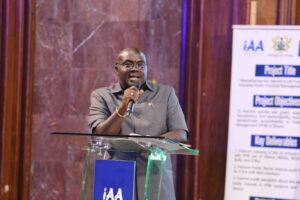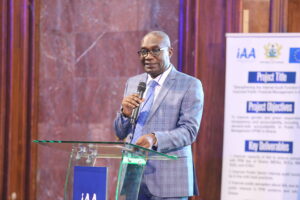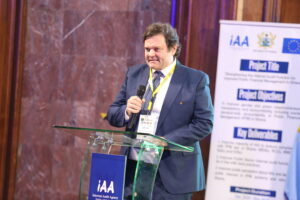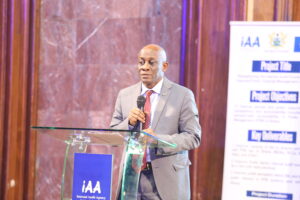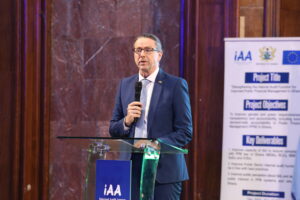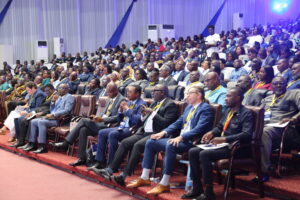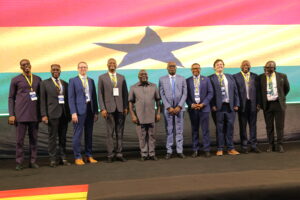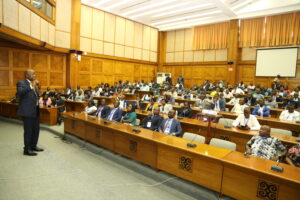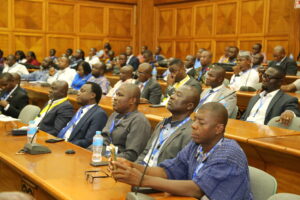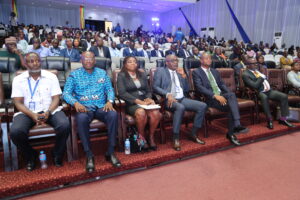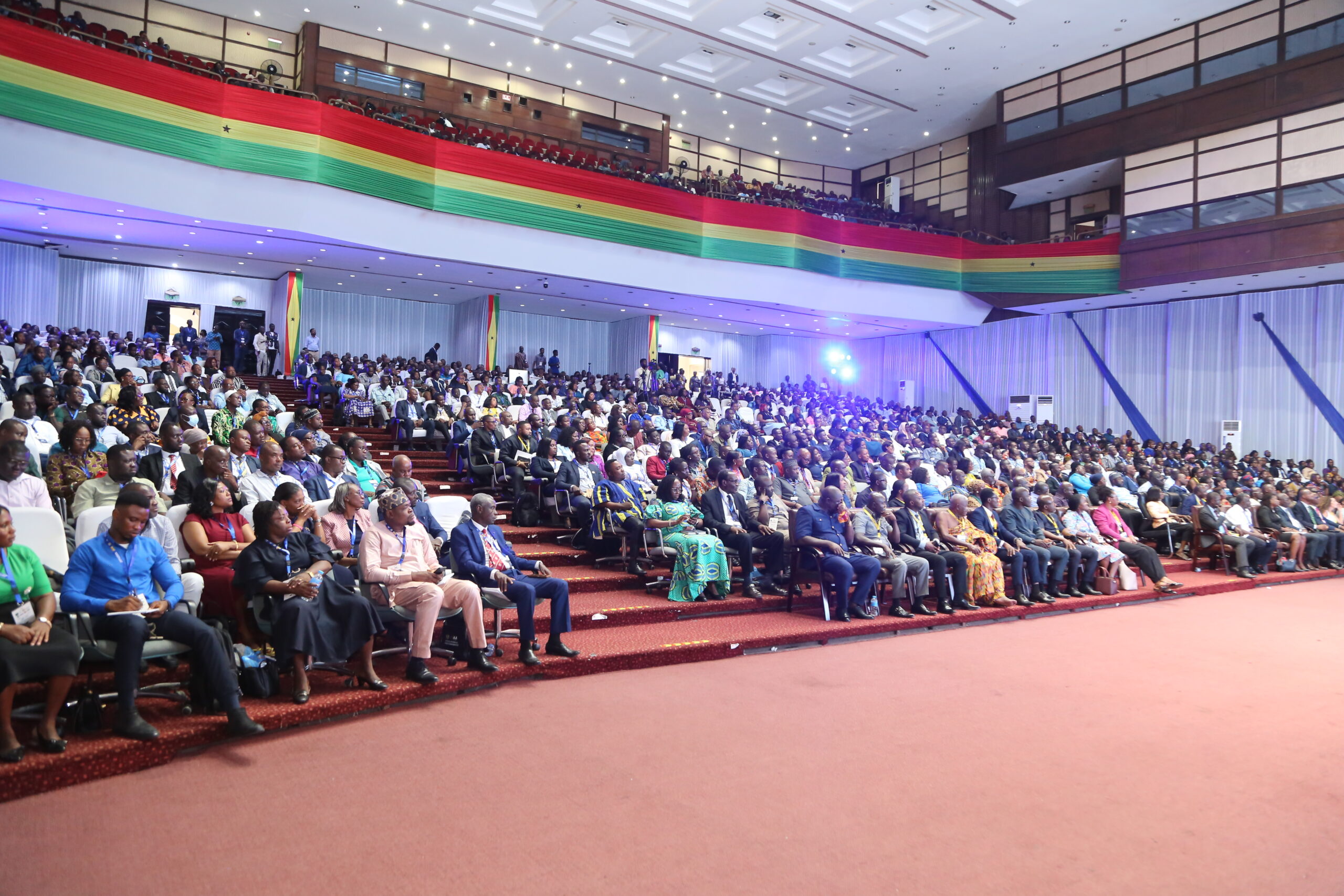

From 3rd – 4th November, 2025, the Internal Audit Agency (IAA), held its annual flagship program, the Annual Internal Audit Conference, at the Accra International Conference Centre. The theme for the Conference was “Resetting the Ghanaian Economy: The Role of the Internal Auditor”. Hon. Julius Debrah, Chief of Staff at the Office of the President, represented H.E. John Dramani Mahama, President of the Republic of Ghana as the Guest of Honour. The Chairperson for the Conference was Prof. Raymond Akongburo Atuguba.
DAY 1
The Conference brought together influential figures from Ghana’s financial and governance sectors to chart a course for crucial reforms, digital transition, and strengthened economic strategy. The topics for discussion centred on the critical importance of operational independence, fiscal discipline, and value for money in public sector financial management.
In his welcome address, the Ag. Director-General of IAA, Mr. Thomas A. Thompson-Aryee underscored the non-negotiable need for professionalism and integrity among Internal Auditors.
Mr. Thompson-Aryee announced an ambitious target for the IAA: a complete digital transformation in 2026, aiming to move the Agency from a “file paper” system to entirely “paperless” operations. Crucially, he stressed the importance of collaborating with the Ministry of Finance to secure dedicated funding that would enhance compliance and guarantee the operational independence of Audit Committees (ACs).
Presidential Representative’s Message: Hon. Julius Debrah, representing the President of Ghana, emphasized that the IAA and its internal auditors are essential in providing expert advice to aid the current administration in fulfilling its mandate.
Economic Advisor’s Address: Hon. Seth Terkper, the Economic Advisor to the President, delivered a powerful reminder: “Nobody is the owner of the valuables of Government assets.” He strongly urged the audience to work with Parliament to expedite the review of the Internal Audit Agency Act to ensure it effectively covers and addresses past financial infractions.
Development partners expressed confidence in the IAA’s path:
World Bank’s Praise: A message from the World Bank noted that the IAA’s dedication and efficiency have achieved a “huge maximum” in its implementation benchmark. The Bank pledged support for software and facilities deployment to aid the IAA in its transition from largely manual operations.
GIZ’s Zero Tolerance: The German Development Agency, GIZ, reaffirmed its strict policy areas of zero tolerance: no sexual harassment and no violence.
Dr. Ishmael Dodoo, Director and Head of Partnership Markets of the 24-Hour Economy Secretariat, delivered a keynote defining the “24 Hour Economy” as a key catalyst for Industrialization, export promotion, and job creation. He detailed several programmatic pillars, including “Build 24,” which focuses on addressing Engineering construction and building needs.
Prof. Abdallah Ali-Nakyea provided critical insights into the Nexus between Monetary and Fiscal policies and the essential knowledge auditors must possess. He offered stern advice, suggesting that the conduct of Heads of Internal Audit must be closely monitored to prevent them from colluding with or aiding senior officials in executing fraudulent activities.
In a subsequent Concurrent Session, Mr. Ebenezer Tackie Yaoboi highlighted the Ministry of Finance’s forward-looking plan to transition all government systems to the Electronic Fiscal System (E-Fiscal System) by the following year.
DAY 2
Day Two of the Annual Internal Audit Conference was a crucial convergence point for policy, compliance, and professional development, focusing heavily on enhancing public financial management and recognizing excellence within the auditing sector. The day was divided into an intensive Plenary Session, a focus on staff well-being, and a celebratory Awards Ceremony.
Mr. Benjamin Sowah Adjetey (Director, Compliance, MoF) delivered a critical presentation on the Guidelines on Commitment Control Compliance.
He defined Public Financial Management (PFM) as the comprehensive system of laws, rules, and institutions governing public revenue mobilization, spending, and accountability to ensure public services are delivered efficiently and sustainably.
The establishment of the PFM-Compliance Division (PFM-CD) was highlighted as a focused effort on preventive, detective, and corrective control measures to restore stability by tackling recurring irregularities.
Mr. Adjetey also detailed strict Commitment Control Measures, including mandatory Commitment Authorization for high-value procurements, use of the Ghana Electronic Procurement System (GHANEPS), and the submission of quarterly Commitment Control Compliance Checklists (CCCCs).
The session concluded with a warning on offences, surcharge, and penalty, listing infractions that lead to sanctions, such as making unauthorized commitments, failure to collect monies due, and authorizing expenditure exceeding the approved appropriation.
The afternoon transitioned from technical compliance to professional development and recognition. Dr. Pascal Brenya (Human Capital Developer) led a session on Stress Management, a vital topic given the precision and integrity demanded by the audit profession. The session covered the causes and detrimental effects of unproductive stress on audit quality, concentration, and ethical decision-making.
THE AWARDS
Various categories of awards were given to deserving participants.
Institutional Excellence: Awards were presented to high-performing Internal Audit Units across Metropolitan, Municipal, and District Assemblies (MMDAs); Ministries, Departments, and Agencies (MDAs); State-Owned Enterprises (SOEs); and Tertiary Institutions, recognizing their commitment to accountability.